what happened to mccarthy as a result of the hearing
| Regular army–McCarthy hearings | |
|---|---|
 Joseph McCarthy (left) chats with Roy Cohn at the hearings | |
| Outcome | Senate hearing derived from Senator Joseph McCarthy'due south hunt for communists in the US |
| Time | Apr–June 1954 |
| Place | Washington DC |
| Participants | The ii sides of the hearing:
|
| Chairman | Senator Karl Mundt |
| Result | End of the McCarthy era |
The Army–McCarthy hearings were a series of hearings held by the U.s.a. Senate's Subcommittee on Investigations (April–June 1954) to investigate conflicting accusations between the United states Regular army and U.S. Senator Joseph McCarthy. The Regular army accused Chief Committee Counsel Roy Cohn of pressuring the Regular army to give preferential treatment to G. David Schine, a former McCarthy aide and friend of Cohn'due south. McCarthy counter-charged that this accusation was made in bad faith and in retaliation for his recent aggressive investigations of suspected communists and security risks in the Regular army.
Chaired past Senator Karl Mundt, the hearings convened on March sixteen, 1954, and received considerable press attention, including gavel-to-gavel live television receiver coverage on ABC and DuMont (April 22 – June 17). The media coverage, particularly television, profoundly contributed to McCarthy's decline in popularity and his eventual censure by the Senate the post-obit December.
Background [edit]
McCarthy came to national prominence in February 1950 after giving a speech in Wheeling, West Virginia, in which he claimed to accept a list of 205 State Section employees who were members of the Communist Party.[1] McCarthy claimed the listing was provided to and dismissed by then-Secretary of State Dean Acheson, proverb that the "State Department harbors a nest of Communists and Communist sympathizers who are helping to shape our foreign policy".[ii] In January 1953, McCarthy began his second term and the Republican Political party regained control of the Senate; with the Republicans in the majority, McCarthy was made chairman of the Senate Committee on Regime Operations.[3] This committee included the Permanent Subcommittee on Investigations, and the mandate of this subcommittee immune McCarthy to utilize it to carry out his investigations of communists in the government.[4] McCarthy appointed 26-yr-old Roy Cohn as principal counsel to the subcommittee and future Attorney General Robert F. Kennedy as assistant counsel, while reassigning Francis Flanagan to the advertizing hoc position of general counsel.[five]
In 1953, McCarthy's committee began inquiries into the United States Ground forces, starting by investigating supposed communist infiltration of the Army Signal Corps laboratory at Fort Monmouth.[6] McCarthy's investigations were largely fruitless, only after the Army accused McCarthy and his staff of seeking special treatment for Private G. David Schine, a master consultant to the Senate Permanent Subcommittee on Investigations and a shut friend of Cohn's who had been drafted into the Army as a private the previous year, McCarthy claimed that the accusation was made in bad religion.[7]
Research [edit]
The Senate decided that these conflicting charges should be investigated and the appropriate committee to do this was the Senate Permanent Subcommittee on Investigations, unremarkably chaired by McCarthy. Since McCarthy was i of the targets of the hearings, Senator Karl Mundt (R-S Dakota) was reluctantly[8] appointed to replace McCarthy as chairman of the subcommittee. John G. Adams was the Ground forces's Counsel.[nine] Acting as Special Counsel was Joseph Welch of the Boston police force firm of Hale & Dorr (at present chosen WilmerHale).[10] The hearings were broadcast nationally on the new ABC and DuMont networks, and in function by NBC.[eleven] Francis Newton Littlejohn, the news director at ABC, made the decision to cover the hearings alive, gavel-to-gavel.[12] The televised hearings lasted for 36 days and an estimated fourscore meg people saw at to the lowest degree part of the hearings.[thirteen]
Photograph [edit]
While the hearings went on, a photograph of Schine was introduced, and Joseph Welch accused Cohn of doctoring the epitome to prove Schine lonely with Regular army Secretarial assistant Robert T. Stevens.[14] On the witness stand Cohn and Schine both insisted that the picture entered into evidence (Schine and Stevens alone) was requested past Stevens and that no ane was edited out of the photo. Welch then produced a wider shot of Stevens and Schine with McGuire AFB wing commander Colonel Jack Bradley continuing to Schine's correct. A fourth person also edited out of the picture (his sleeve was visible to Bradley's right in the Welch photograph) was identified every bit McCarthy aide Frank Carr.[15]
Hoover memo [edit]
After the photograph was discredited, McCarthy produced a copy of a confidential letter of the alphabet he claimed was a Jan 26, 1951, memo written and sent past FBI Manager J. Edgar Hoover, to Major General Alexander R. Bolling, alert Army Intelligence of subversives in the Ground forces Signal Corps.[16] McCarthy claimed the letter was in the Army files when Stevens became secretary in 1953, and that Stevens willfully ignored it.[17] Welch was the kickoff to question the letter's validity, challenge that McCarthy's "purported copy" did not come from Army files; McCarthy stated he never received any document from the FBI, just when questioned on the stand up by special Senate counsel Ray Jenkins and cantankerous-examined by Welch, McCarthy, while albeit the document was given to him by an intelligence officeholder, refused to identify his source.
Robert Collier, banana to Ray Jenkins, read a letter of the alphabet from Chaser General Herbert Brownell Jr., in which he stated that Hoover examined the document and that he neither wrote nor ordered the letter, and that no such re-create existed in FBI files, rendering McCarthy's claims meritless, and the letter spurious.
Homosexuality [edit]
Though the hearings were primarily about regime subversion, they occasionally took on accusations of a more taboo nature: a portion of the hearings assessed the security adventure of homosexuals in government. The issue remained an undercurrent throughout the hearings. One such case of this undercurrent was an substitution between Senator McCarthy and Joseph Welch. Welch was questioning McCarthy staff fellow member James Juliana about the unedited picture of Schine with Stevens and Bradley, asking him "Did yous think this came from a Pixie?" (a type of camera popular at the time), at which indicate McCarthy asked to take the question re-read:[18]
McCarthy. Volition counsel [i.e. Welch] for my benefit define – I think he might be an skilful on that – what a pixie is?
Welch. Aye. I should say, Mr. Senator, that a pixie is a shut relative of a fairy. (Laughter from the sleeping room) Shall I proceed, sir? Have I aware yous?
McCarthy. Every bit I said, I think you may be an potency on what a pixie is.[19]
Cohn, Schine and McCarthy [edit]
At least a portion of the Army's allegations were correct. Roy Cohn did take steps to request preferential treatment for Schine, going and then far on at to the lowest degree one occasion to sign McCarthy's name without his knowledge on a request for Schine to have access to the Senators' Baths, a pool and steam room reserved exclusively for senators.[twenty]
The verbal human relationship between Cohn, McCarthy and Schine remains unknown. Cohn and Schine were certainly close, and rather than work out of the Senate offices, the two rented nearby function space and shared bills. McCarthy commented that Cohn was unreasonable in matters dealing with Schine. It is unclear if Schine ever had a romantic or sexual relationship with Cohn, who was a closeted homosexual. (Three years after the hearings, Schine married and eventually had six children.) Some have also suggested that McCarthy may have been homosexual, and was even possibly involved with Schine or Cohn.[21] [22] [23]
Joseph Welch confronts McCarthy [edit]
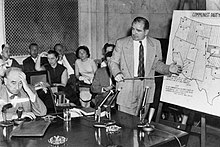
In what played out to be the most dramatic exchange of the hearings, McCarthy responded to aggressive questioning from Army counsel Joseph Welch. On June nine, 1954, twenty-four hours xxx of the hearings, Welch challenged Cohn to give McCarthy's list of 130 subversives in defense plants to the role of the FBI and the Section of Defense "before the sun goes down".[24] In response to Welch'southward challenge, McCarthy suggested that Welch should check on Fred Fisher, a young lawyer in Welch's own Boston constabulary firm whom Welch had planned to have on his staff for the hearings.[25] McCarthy then mentioned that Fisher had once belonged to the National Lawyers Guild (NLG), a group which Attorney Full general Brownell had chosen "the legal bulwark of the Communist Party".[26]
Welch revealed he had confirmed Fisher's one-time membership in the National Lawyers Order approximately six weeks earlier the hearings started.[27] Later Fisher admitted his membership in the National Lawyers Guild, Welch decided to send Fisher dorsum to Boston.[28] His replacement by some other colleague on Welch's staff was also covered past The New York Times.[29] [xxx] Welch so reprimanded McCarthy for his needless attack on Fisher, maxim "Until this moment, Senator, I think I never really gauged your cruelty or your recklessness."[31] McCarthy, accusing Welch of filibustering the hearing and baiting Cohn, dismissed Welch'south dissertation and casually resumed his assault on Fisher, at which point Welch angrily cut him brusque:[25]
Senator, may we not drop this? We know he belonged to the Lawyers Social club ... Let us non assassinate this lad farther, Senator; yous've done enough. Have yous no sense of decency, sir? At long last, have yous left no sense of decency?
Welch excluded himself from the residuum of the hearings with a parting shot to McCarthy:[32] "Mr. McCarthy, I will not discuss this further with you ... You accept seen fit to bring [the Fisher/NLG affair] out, and if there is a God in heaven, it volition exercise neither you lot nor your cause whatsoever skilful! I will not discuss it further ... Y'all, Mr. Chairman, may as yous will, call the next witness!"[33] Later on Welch deferred to Chairman Mundt to call the next witness, the gallery flare-up into adulation.[34]
Conclusion and backwash [edit]
About the finish of the hearings, McCarthy and Senator Stuart Symington (D-Missouri) sparred over the handling of secret files by McCarthy's staff. McCarthy staff director Frank Carr testified that everyone who worked on McCarthy'south staff had access to classified files regardless of their level of security clearance. Symington hinted that some members of McCarthy'south own staff might themselves be subversive and signed a document like-minded to take the stand in the hearings to reveal their names in return for McCarthy's signature on the same document agreeing to an investigation of his staff. Just McCarthy, after calling Symington "Sanctimonious Stu", refused to sign the agreement, claiming it contained false statements, and chosen the accusations an "unfounded smear" on his men. He then rebuked Symington by saying "You lot're not fooling anyone!" Just Symington retaliated with a prophetic remark of his own: "Senator, the American people have had a expect at you at present for 6 weeks; you're not fooling anyone, either."[35]
In Gallup polls from January 1954, McCarthy's approval rating was at l%, with only 29% disapproving. By June, both percentages had shifted by 16%, with more than people (34% approving, 45% disapproving) now rejecting McCarthy and his methods.[36]
Afterward hearing 32 witnesses and two one thousand thousand words of testimony, the committee ended that McCarthy himself had not exercised whatever improper influence on Schine's behalf, but that Roy Cohn, McCarthy'southward chief counsel, had engaged in some "unduly persistent or aggressive efforts" for Schine. The conclusion besides reported questionable beliefs on the office of the Ground forces: that Secretarial assistant Stevens and Army Counsel John Adams "fabricated efforts to terminate or influence the investigation and hearings at Fort Monmouth", and that Adams "made vigorous and diligent efforts" to block subpoenas for members of the Army Loyalty and Screening Lath "by means of personal appeal to certain members of the [McCarthy] committee". Before the official reports were released, Cohn had resigned equally McCarthy's master counsel, and Senator Ralph Flemish region (R, Vermont) had introduced a resolution of censure against McCarthy in the Senate.[37]
Despite McCarthy'southward amortization of misconduct in the Schine matter, the Army–McCarthy hearings ultimately became the main catalyst in McCarthy'south downfall from political power. Daily paper summaries were increasingly unfavorable toward McCarthy,[38] [39] while television audiences witnessed firsthand the unethical tactics of the junior Senator from Wisconsin.
On Dec ii, 1954, the Senate voted 67–22 to censure McCarthy, finer eradicating his influence, though not expelling him from office.[40] McCarthy continued to chair the Subcommittee on Investigations until January 3, 1955, the solar day the 84th United States Congress was inaugurated; Senator John 50. McClellan (D-Arkansas) replaced McCarthy as chairman.
Fred Fisher was relatively unaffected by McCarthy's charges and went on to become a partner in Boston'due south prestigious Hale & Dorr constabulary firm and organized its commercial law department. He also served equally president of the Massachusetts Bar Association and equally chairman of many committees of the American and Boston bar associations.[41]
After his censuring, Senator McCarthy continued his anti-communist oratory, often speaking to an empty or nigh-empty Senate bedchamber. Turning increasingly to booze, McCarthy died of hepatitis on May 2, 1957, at the age of 48.[42]
See likewise [edit]
- McCarthyism
- Indicate of Order!
- House Un-American Activities Committee
- United States Senate Subcommittee on Internal Security
References [edit]
- ^ "'Enemies from Within': Senator Joseph R. McCarthy's Accusations of Disloyalty". George Stonemason University.
- ^ Robert J. Donovan (1996). Tumultuous Years: The Presidency of Harry S. Truman, 1949–1953 . University of Missouri Press. pp. 162. ISBN978-0826210852.
- ^ "Joseph R. McCarthy (1908–1957)". George Washington University. 2006.
- ^ "The Man Behind McCarthyism: A Gateway". Academy of Albany.
- ^ Luke Fowler, Jeffrey Markham. "John C. Stennis and the Censure of Joseph McCarthy" (PDF). Mississippi Land University. Archived from the original (PDF) on June 10, 2010.
- ^ "McCarthy's Downfall". Mount Holyoke Higher. Archived from the original on August 8, 2013. Retrieved Baronial 23, 2013.
- ^ "M. David Schine". The New York Times. June 5, 1977. Retrieved April 1, 2008.
Xx-3 years ago this month, the curtain rang downward on i of Washington'southward greatest television dramas: Ground forces-McCarthy hearings. At the start, the focus was on Thou. David Schine, an Army private who had been chief consultant to the Senate Permanent Subcommittee on Investigations, which Senator Joseph R. McCarthy headed.
- ^ Emile de Antonio (director, editor), Robert Duncan (co-editor) (1964). Point Of Lodge! (Documentary Film). Washington D.C.: New Yorker Films.
'Presiding over these hearings is a responsibleness that I do not welcome.' said by Senator Karl Mundt near beginning of movie
- ^ "John Grand. Adams, Army's Counsel In McCarthy Hearings, Dies at 91". Washington Post. June 27, 2003. Retrieved March fifteen, 2008.
Mr. Adams, an Ground forces veteran of Globe State of war 2, worked on Capitol Hill and for the Defense Department before being named Army full general counsel in 1953.
- ^ Geoffrey Grand. Pullum (June 9, 2004). "At Long Last". upenn.edu. University of Pennsylvania.
- ^ "N.B.C. Halts Live Television On Army, McCarthy". The New York Times. April 25, 1954. Retrieved April i, 2008.
The National Broadcasting Company'due south goggle box network commencement tomorrow will stop carrying live pickups from the Army–McCarthy hearings in Washington, because 'it cost us a lot of coin last week' and might toll advertising goodwill.
- ^ Holley, Joe (Dec nine, 2005). "Francis Littlejohn Dies. Aired Full McCarthy Hearings on ABC". Washington Post . Retrieved March 15, 2008.
Francis Newton 'Fritz' Littlejohn, 97, news manager at ABC in 1954 when the network provided gavel-to-gavel coverage of the Army–McCarthy hearings, died of cardiac arrest November 24 at his home in New York City.
- ^ Dorothy Rabinowitz (November 22, 2012). "A Proper noun That Lives in Infamy Enemies Within: Joe McCarthy". The Wall Street Periodical.
- ^ Drogin, Bob (Baronial three, 1986). "Roy Cohn, Hero and Villain of McCarthy Era, Dies at 59". Los Angeles Times . Retrieved November xiii, 2015.
Millions of Americans watched the existent-life Goggle box drama equally McCarthy and Cohn tangled with top Ground forces officials, trading bitter charges and accusations. Army counsel John Thou. Adams testified that Cohn had threatened to 'wreck the Regular army.' Regular army special counsel Joseph N. Welch also accused Cohn of doctoring a photograph that was introduced as evidence.
(Subscription required.) - ^ "National Affairs: Role of the Moving-picture show". Time. May 10, 1954.
- ^ "Army Signal Corps – Subversion and Espionage Hearing Earlier the Permanent Subcommittee on Investigations of the Committee on Authorities Operations Usa Senate". National Archives and Records Administration. 1954.
- ^ "National Affairs: The Bogus Letter". Time. May 17, 1954.
- ^ James Cross Giblin (2009). The Rise and Fall of Senator Joe McCarthy. Houghton Mifflin Harcourt. pp. 222–225. ISBN978-0547443188.
- ^ Shogan, Robert (2009). No Sense Of Decency: The Ground forces–McCarthy Hearings . Ivan R. Dee. p. 178. ISBN978-1615780006.
- ^ Executive Sessions of the Senate Permanent Subcommittee on Investigations of the Committee on Regime Operations, Book 5 (PDF). Regime Printing Role. January 2003. sixteen.
- ^ Miller, Neil (1995). "Out of the By: Gay and Lesbian History from 1869 to the Present". New York: Vintage Books. Archived from the original on September 2, 2009.
- ^ Baxter, Randolph (November 13, 2006). "An Encyclopedia of Gay, Lesbian, Bisexual, Transgender, and Queer Culture". glbtq, Inc. Archived from the original on December 8, 2006.
Tall, rich, and suave, the Harvard-educated (and heterosexual) Schine contrasted starkly with the brusque, physically undistinguished, and caustic Cohn.
- ^ Wolfe, Tom (April 3, 1988). "Dangerous Obsessions". The New York Times.
Simply so far as Mr. Schine is concerned, there has never been the slightest testify that he was anything just a good-looking kid who was having a helluva good fourth dimension in a helluva good cause. In any issue, the rumors were sizzling away
- ^ Robert Perske (April 2005). "Elementary Decency" (PDF). Robert Perske. Retrieved November 13, 2015.
- ^ a b "'Have Yous No Sense of Decency': The Ground forces–McCarthy Hearings". George Mason Academy. Retrieved November 13, 2015.
- ^ Powell, Michael (July 28, 2006). "Anatomy of a Counter-Bar Clan: The Chicago Council of Lawyers" (PDF). Police force & Social Inquiry. 4 (iii): 503. doi:10.1111/j.1747-4469.1979.tb01027.x. Retrieved March 1, 2009. [ dead link ] (Subscription required.)
- ^ "McCarthy volition Boycott Research Pending on Action on News Leak". The New York Times. April 16, 1954. pp. one, 12. The Ground forces charges were signed by its new special counsel, Joseph N. Welch. Mr. Welch today [April 15] confirmed news reports that he had relieved from duty his original 2d assistant, Frederick Grand. Fisher Jr., of his own Boston law role because of admitted previous membership in the National Lawyers Society, which has been listed past Herbert Brownell Jr. the Attorney General, every bit a Communist front organization. Mr. Welch said he had brought in another lawyer, John Kimball Jr., from his Boston office to take Mr. Fisher's place.
- ^ Eugene L. Solomon (2010). Lies and Deceits. iUniverse. p. 365. ISBN978-1440198090.
- ^ "McCarthy volition Cold-shoulder Inquiry Pending on Action on News Leak". The New York Times. April 16, 1954. pp. 1, 12.
- ^ Stanton Evans, M. (November half dozen, 2007). Blacklisted by History: The Untold Story of Senator Joe McCarthy and His Fight Confronting America's Enemies. ISBN9780307238665.
- ^ "June nine, 1954 'Accept You No Sense of Decency?'". Senate Stories: 1941–1963. U.South. Senate. Retrieved November 13, 2015.
- ^ Fettmann, Eric. "The Commencement 'Reality Show'". New York Postal service . Retrieved November 13, 2015.
- ^ W. H. Lawrence (June 9, 1954). "Welch Assails Chiliad'Carthy's 'Cruelty' And 'Recklessness' In Assault On Adjutant; Senator, On Stand, Tells Of Ruby-red Hunt". The New York Times . Retrieved November 13, 2015.
- ^ Murrey Marder (June 10, 1954). "Welch vs. McCarthy". The Washington Post . Retrieved November 13, 2015.
- ^ Powers, Richard Gid (1998). Not Without Laurels: The History of American Anticommunism. Yale University Press. p. 271. ISBN0-300-07470-0.
- ^ Fried, Richard Chiliad. (1990). Nightmare in Red: The McCarthy Era in Perspective. Oxford University Printing. p. 138. ISBN0-19-504361-8.
- ^ "The Censure Case of Joseph McCarthy of Wisconsin (1954)". United States Senate. Retrieved November xiii, 2015.
- ^ Morgan, Ted (2004). Reds: McCarthyism in Twentieth-Century America. Random House. p. 489. ISBN0-8129-7302-X.
- ^ Streitmatter, Rodger (1998). Mightier Than the Sword: How the News Media Have Shaped American History. Westview Printing. p. 167. ISBN0-8133-3211-7.
- ^ The New York Times (December ii, 2011). "Dec. ii, 1954: Anti-Communist Senator McCarthy Is Condemned". The New York Times . Retrieved Nov xiii, 2015.
- ^ "Fisher Program". Briefing on Consumer Finance Law. Retrieved Nov 13, 2015.
- ^ Shogan, Robert (March i, 2009). No Sense Of Decency: The Army–McCarthy Hearings . Ivan R. Dee. p. 261. ISBN978-1615780006.
Further reading [edit]
- Adams, John K. (1983). Without Precedent: The Story of the Expiry of McCarthyism . Due west. W. Norton & Visitor. ISBN0-393-01616-ane.
- Straight, Michael (1979). Trial by Boob tube and Other Encounters. Devon Publishers. ISBN0-934160-03-1.
External links [edit]
- Transcript of Army–McCarthy hearings, missing volumes 8–11, 28–31, 48–54
- Executive Sessions of the Senate Permanent Subcommittee on Investigations of the Commission on Government Operations
- The Ground forces–McCarthy hearings
- McCarthy–Welch exchange "Have You lot No Sense of Decency" (transcript and audio file)
- Point of Order! at IMDb
- Welch–McCarthy confrontation, The New York Times
Source: https://en.wikipedia.org/wiki/Army%E2%80%93McCarthy_hearings
0 Response to "what happened to mccarthy as a result of the hearing"
Enregistrer un commentaire